


Arabic Voice & Conversational AI
SAWTRA
Arabic voice AI connecting spoken requests to permitted service actions, with customer confirmation, human intervention and signed records of execution.
The Customer Case
The Opportunity
Arabic-speaking service organisations need useful automation that fits their customer identity, contact channels and operating controls. A design-partner evaluation should measure task completion, handover quality, speech performance and cost per resolved interaction against the existing service. Live banking use remains subject to integration and independent acceptance.
Bring a Customer PerspectiveWhat We Are Building
The Product
SAWTRA develops voice and conversational AI for Arabic-speaking organisations. Its engineering foundation connects speech, dialogue, customer authority and signed action records, with a bounded banking pilot covering balance enquiries, confirmed card blocking and human-led dispute intake.
- Development Focus
- Arabic Voice & Conversational AI
How It Fits Together
The System
A real-time speech path feeds a policy-gated dialogue engine. Customer permissions and explicit confirmation govern consequential actions; signed session records preserve what the system attempted, what happened and when human intervention was required.
Critical Dependencies
- Representative Arabic telephone data and qualified speech models
- Customer identity, bank or service connectors, and human handover
- Deployment residency, operational support and independent acceptance
System Architecture
How the proposed elements connect.
Speech & Dialogue
Arabic speech and dialogue connect a spoken request with a bounded service intent.
Authority & Action
Customer permissions and explicit confirmation govern consequential tool execution and human handover.
Records & Acceptance
Signed records support review; real speech, integration and deployment acceptance remain development requirements.
Conceptual system view. The development questions below set out what needs to be established.
The Next Technical Decisions
Evaluation
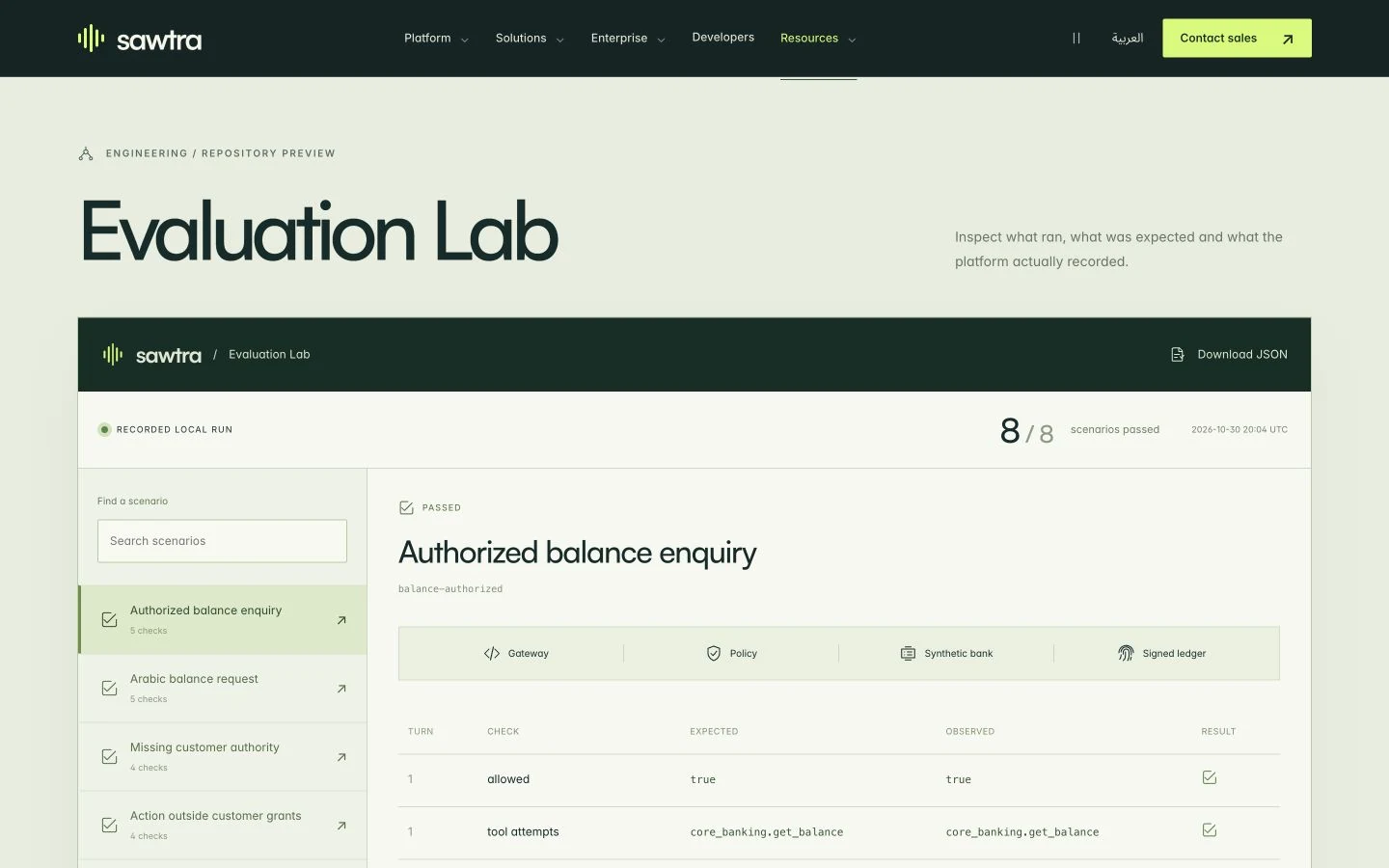
The supplied engineering materials include a recorded local evaluation of the gateway, authorisation controls and signed ledger. Real telephone speech, deployed bank integration and live-service acceptance remain to be established.
How accurately and naturally does the system handle real telephone speech, dialect variation, interruptions and Arabic–English code-switching?
Can customer authority, confirmation, bank outcomes and human handover remain reliable across failures and recovery?
Can an intended deployment demonstrate data residency, service quality, operating support and customer acceptance?
Questions & Answers
SAWTRA
FAQs
Technical scope, development requirements and ways to contribute.
Ask About SAWTRAWhat Is SAWTRA?
SAWTRA develops Arabic voice and conversational AI for organisations that need spoken requests to connect with controlled service actions. Speech and dialogue sit alongside customer permissions, confirmation, human intervention and verifiable session records.
Who Is SAWTRA Being Built For?
The initial banking focus is Arabic-speaking customer service. The broader architecture can support other service organisations, but each use needs its own scope, connectors, permissions and acceptance criteria. A sector demonstration does not establish an approved production service.
What Is the Current Banking Scope?
The bounded banking pilot covers balance enquiries, explicit confirmation before a card is blocked, and dispute intake that hands responsibility to a person. The current scope does not establish autonomous money movement or unrestricted access to customer accounts.
Is SAWTRA Ready for Live Banking Customers?
The current engineering foundation has local component and integration evidence. Live banking acceptance remains outstanding, including real speech performance, customer identity and bank integration, deployment controls and operational support. The project is not yet approved for live banking customers.
Why Is Arabic More than a Translation Requirement?
Useful voice service must handle dialect variation, code-switching, numbers, dates, interruptions and telephone audio. SAWTRA treats these as speech and dialogue requirements. Performance must be established on representative recordings and listening studies for the intended users.
How Are Customer Actions Controlled?
The architecture separates the request from the authority to execute it. Customer permissions define the allowed action and resource; consequential actions require explicit confirmation. Unclear requests or cases outside the permitted scope should be clarified or handed over.
What Do Verifiable Records Establish?
Signed, tamper-evident session records are intended to support review of recorded requests, permissions, tool attempts, outcomes and human intervention. They help establish what was recorded and whether it changed. They do not prove that every underlying input or model response was correct.
What Does Data Residency Mean for This Project?
Residency controls are part of the proposed deployment and routing architecture. A customer must assess the actual hosting region, media path, provider connections, storage and operating access. An architectural control alone does not establish verified in-country operation.
How Is Human Handover Part of the Service?
People retain responsibility for the cases that require judgement or fall outside the permitted action scope. The evaluation must establish how a case is transferred, what context is provided, who owns resolution and how the outcome is recorded.
How Should Speech Quality and Latency Be Evaluated?
Use representative telephone conditions, dialects and service tasks, with separate measures for recognition, response timing, listening quality and completed outcomes. Local synthetic scenarios can test software controls; they do not substitute for deployed speech and customer-service evidence.
What Would a Design Partner Contribute?
A design partner can define a bounded service journey, provide authorised evaluation data, clarify identity and permission requirements, and supply a controlled integration setting with human support. The work should agree acceptance criteria before expanding the scope.
What Should a Founder, Partner or Investor Discuss First?
Start with the target service, intended users and the next evidence gap. Useful contributions include Arabic speech expertise, customer-service integration, deployment engineering, operating leadership or capital tied to an agreed development plan. Current evidence and responsibilities should be examined for that specific engagement.
Engagement
Work on SAWTRA
Choose the route that fits your contribution. Your enquiry will carry this venture’s name into the conversation.
Enquire About SAWTRABuild the Company
Founders and venture leaders: bring the experience to own the business, product or a critical operating function.
The Founder PathwayExplore an EIR Assignment
Investigate a customer problem, product requirement or development decision. Propose a defined piece of work and a useful outcome.
Discuss an EIR AssignmentContribute a Capability
Research and industry partners: bring a test method, specialist facility, manufacturing process or real customer requirement.
Partnership PathwaysDiscuss Capital
Review the venture’s development plan, evidence, intellectual-property position and financing requirements.
Capital Partner Information